An aircraft that has sat for a few weeks, or flown a few hundred miles since its last clean, never gets dirty evenly. The belly behind the exhaust carries a grey film. The leading edges hold bugs. The gear doors and wheel wells pick up brake dust and grease. The upper surfaces mostly need dust lifting and nothing more.
So we don’t treat it as one job. We dry wash it in two passes, with two products, in a set order.
Pass one: Dend on the dirty areas
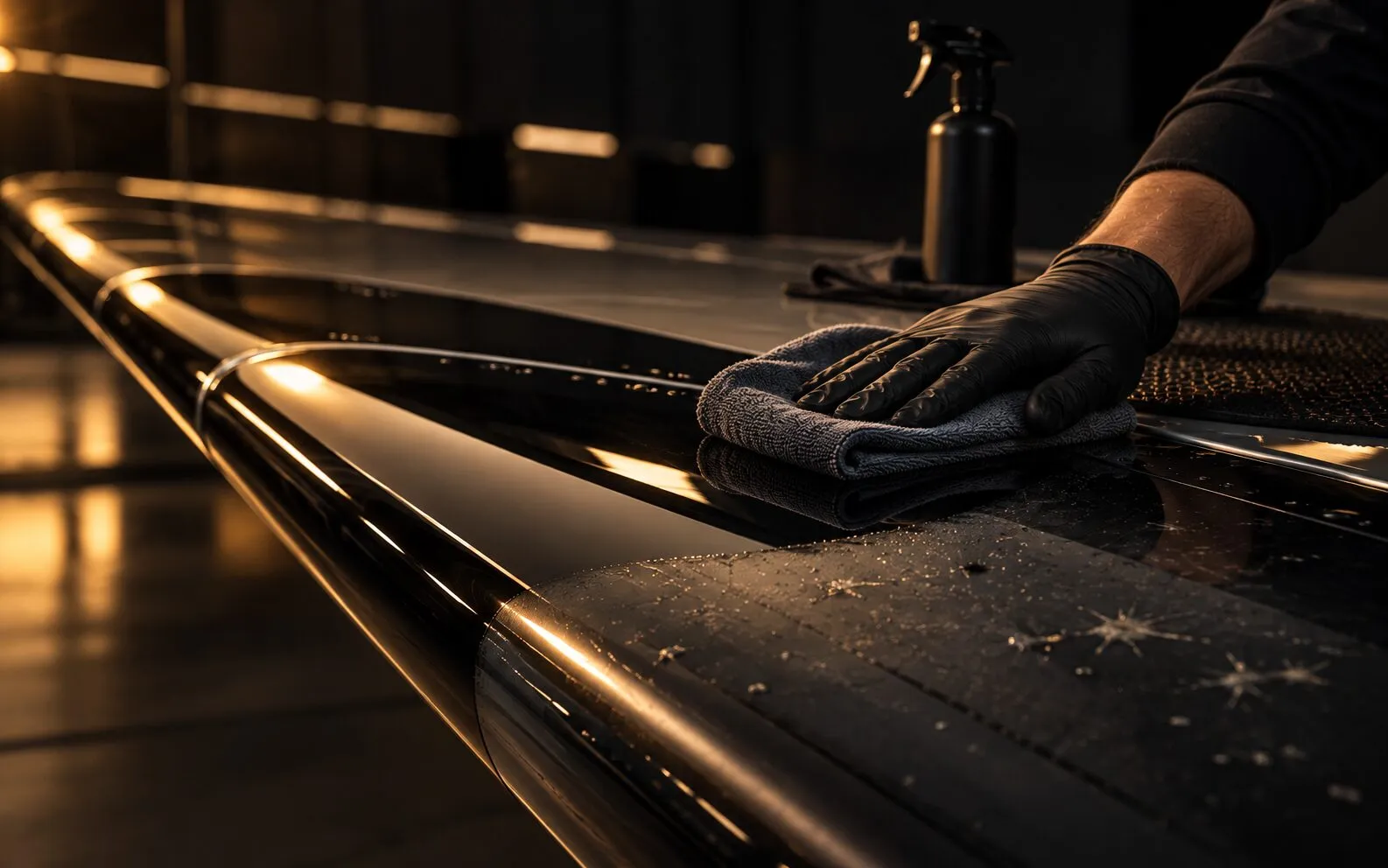
Dend goes on first, and only where the dirt is: exhaust staining, the leading edges, the gear, the wheels, anywhere grease or grime has built up. We mix it at 10 parts water to 1 part Concentrate, spray it on, let it sit for a moment, and wipe it off with a clean microfiber.
On a heavy patch we go round again. Pre-spray, work it gently with a soft pad such as a Doodlebug, wipe, look. We keep going until we’re satisfied with the area, then move on. Dend doesn’t need rushing, and it won’t harm the paint while it works.
When bugs or carbon won’t shift at 10:1, we mix Dend stronger, at 5 parts water to 1 part Concentrate. Very occasionally something is stubborn enough that we use it straight from the container. That’s the exception. At 10:1 Dend handles almost everything we see on an aircraft.
Pass two: sWype over everything
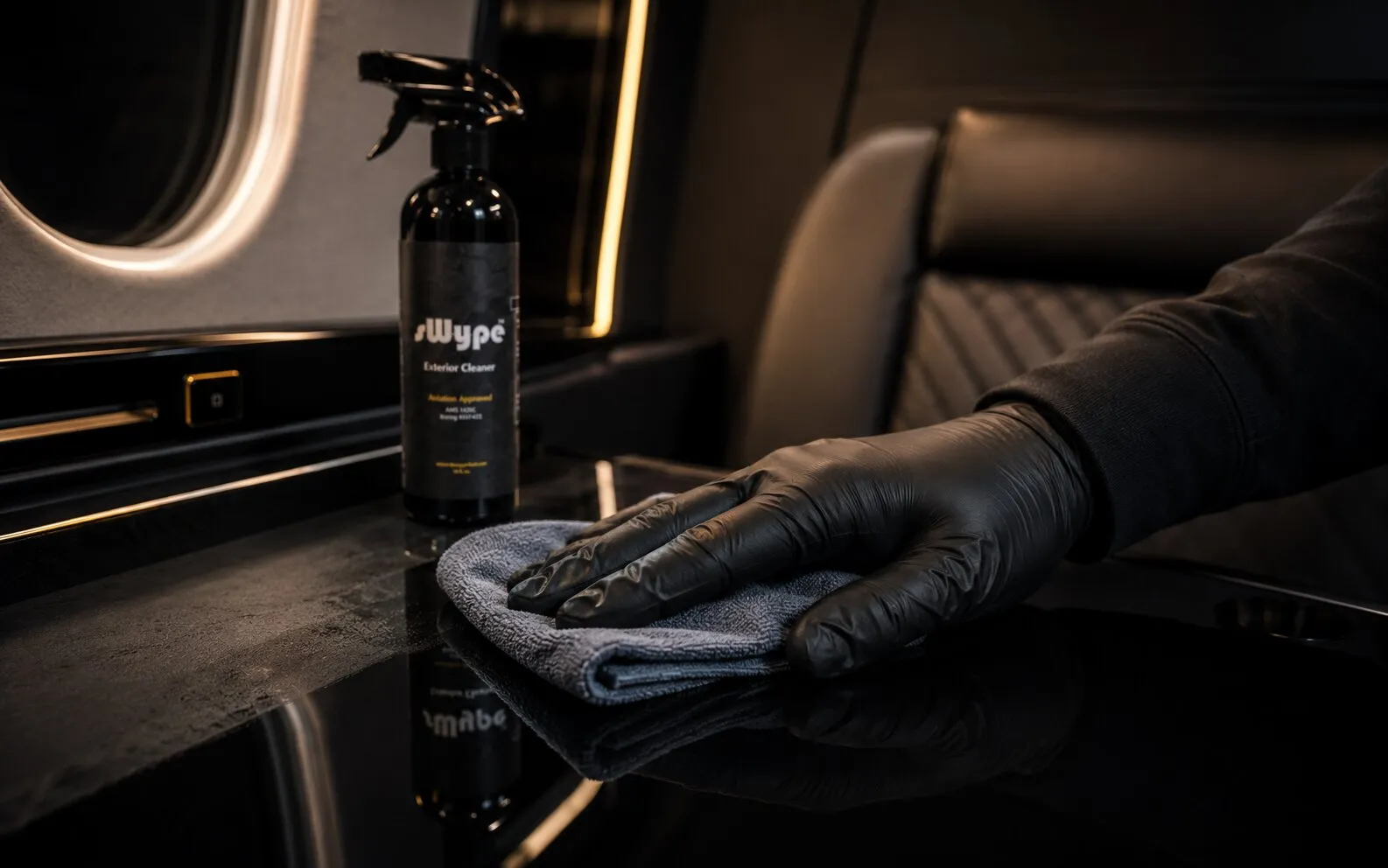
Once the dirty areas are clean, sWype goes over the whole aircraft, again almost always at 10:1. Mist a panel or a folded microfiber, wipe, turn the cloth to a clean face, and buff.
This is the pass people notice. Dend removes what shouldn’t be there. sWype finishes the surface: it lifts the last of the film Dend leaves behind on the dirty areas, takes the dust off everything else, and leaves the paint with an even, deep finish. It doesn’t leave a haze or a slick layer that pulls dust back down.
Glass and acrylic windows get sWype too. That’s one of the reasons it’s the second pass and not a separate product for each surface.
Why it works in that order
Each product does the job it was built for. Dend is a degreaser. It’s made to cut exhaust film, brake dust and bug residue without being harsh on paint. sWype is a finishing cleaner. Asking it to do Dend’s job means more product, more wiping and a worse result on the dirtiest areas. Asking Dend to finish the whole aircraft wastes it on panels that only needed dusting.
Dirty areas first, finish second, and the aircraft comes out the same all over.
At an air show
On a static display the first clean is exactly what’s described above. After that, it’s sWype only. Fingerprints on the paint, dust from the ramp, a smudge on the windscreen after the crowd has been close: sWype and a clean microfiber, every time, as often as it takes. There’s no build-up to strip off at the end of the weekend.
After a wax or a polish
People are sometimes surprised that we use sWype after a fresh wax or paint polish. The paint is already protected, so why wipe it again?
Because it looks better. It’s hard to put into words, but a final pass of sWype over a freshly waxed or polished surface brings out an extra depth in the finish. It isn’t more shine for its own sake, and it doesn’t look wet or tacky. It looks finished, which is the whole point of a final detail product.
Safe on the paint, and on everything else
Both products are made not to harm the paint. That’s the first requirement, not a feature we added later. sWype and Dend conform to AMS 1526C and Boeing BSS7432, the specifications aircraft exterior cleaners are tested against. sWype is readily biodegradable, and Dend is phosphate free.
There are other good cleaners out there, and plenty of them do their job well. What we couldn’t find was a pair built from the start to be safe on the finish and gentle on the environment, so we made one.
The short version
- Dend at 10:1 on the dirty areas until you’re satisfied. 5:1 for stubborn bugs or carbon, and straight Concentrate only for the very worst.
- sWype at 10:1 over the whole aircraft, glass and acrylic included.
- At a show, sWype only after the first clean.
- After a wax or polish, sWype anyway. You’ll see the difference.
Dend and sWype are both available Ready-To-Use and as Concentrate in the shop. For the difference between the formats, see Ready-To-Use vs. Concentrate.